

Victron
Victron Energy - Orion-Tr - Isolated DC-DC Charger Remote Cable
Victron Energy - Orion-Tr - Isolated DC-DC Charger Remote Cable
Couldn't load pickup availability
Victron Orion-Tr Isolated DC-DC Charger Remote Cable: Reliable BMS Integration for Dual-Battery Systems
Purpose-Built Remote Control for Isolated Orion-Tr Chargers
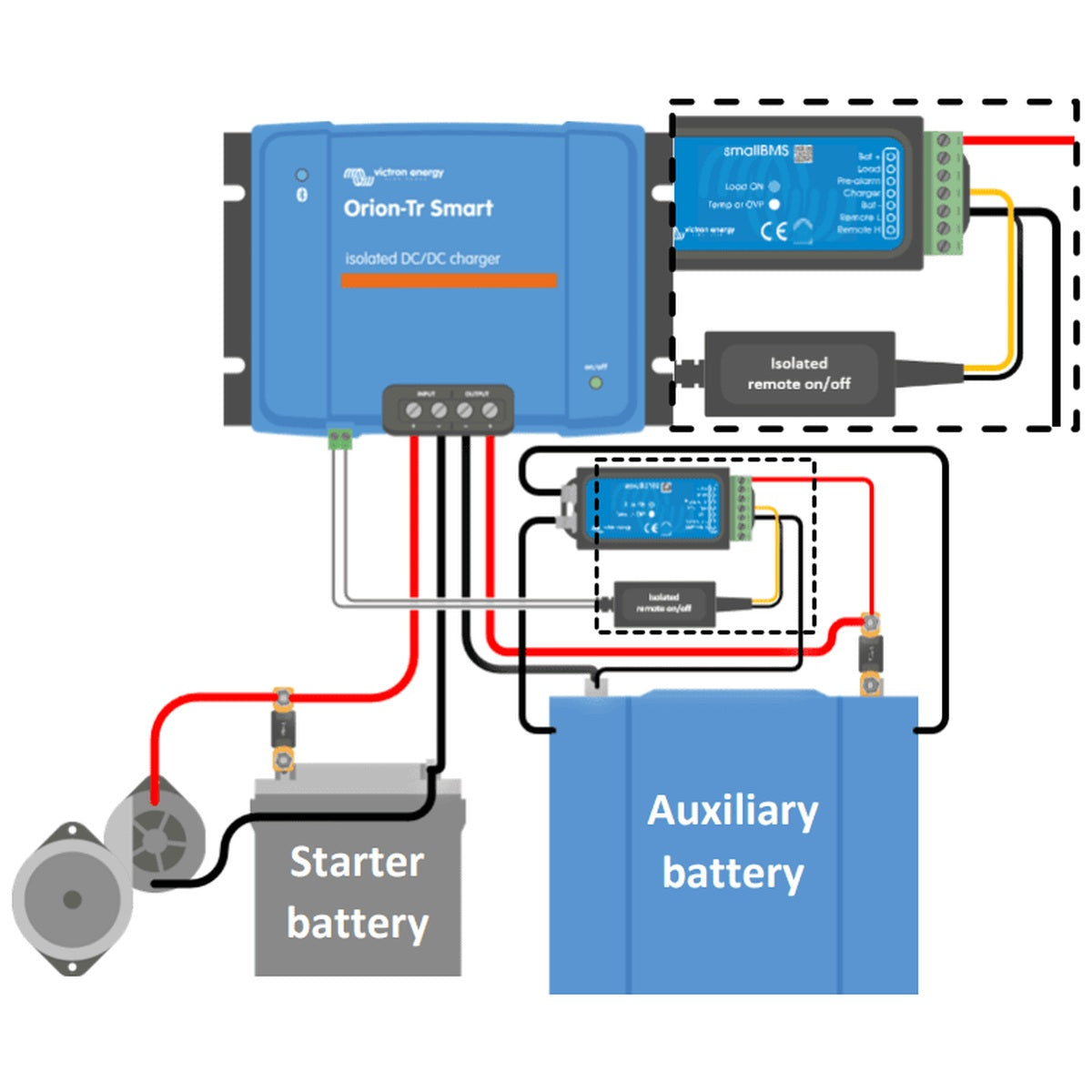
The Victron Orion-Tr Isolated DC-DC Charger Remote Cable enables seamless integration between your Orion-Tr Isolated DC-DC charger and a secondary battery’s Battery Management System (BMS). In standard installations, the remote on/off circuit references the primary battery (such as a starter battery). This cable solves the challenge when the remote signal must originate from the secondary battery—common in lithium battery systems where the BMS controls charging. By providing electrical isolation, it ensures safe, accurate signalling without ground loop interference or voltage mismatch.
How It Works
Inside the cable’s encapsulated inline junction, an opto-isolator circuit separates the primary and secondary battery references. When the BMS sends a pull-down signal (as low as approximately 4 V), the cable translates it to the charger’s remote input, enabling or disabling charging precisely when needed. This protects your lithium battery bank from overcharging or operating outside safe parameters, extending battery life and system reliability.
Key Features
- Electrical isolation between primary and secondary battery references prevents ground loops and voltage conflicts
- Pre-crimped wire ferrules for quick, secure connection to the Orion-Tr remote terminal and BMS control ports
- Encapsulated inline junction resists moisture and vibration, suitable for engine bays and harsh mobile environments
- Wide voltage tolerance—handles input up to 35 V and output up to 70 V, accommodating 12 V, 24 V, and 48 V systems
- Low power consumption—maximum pull-down current approximately 30 mA, with short-circuit protection
Engineered for Demanding Mobile and Off-Grid Applications
This remote cable is essential for installations where the Orion-Tr Isolated DC-DC charger charges a lithium house battery from an alternator or starter battery, and the BMS must actively manage charging. Without proper isolation, voltage differences between battery banks can cause erratic behaviour or damage. The Victron remote cable eliminates this risk, making it a critical component in caravan, motorhome, marine, and 4WD dual-battery systems.
Typical use cases include:
- Connecting a Victron smallBMS or third-party BMS to an Orion-Tr Isolated charger
- Enabling automated charge control based on cell voltages, temperature, or state of charge
- Retrofitting existing systems where the remote signal must be referenced to the secondary battery
Installation Simplicity
The cable comes with clearly labelled wires: two grey wires with ferrules for the charger’s remote terminal, and yellow/black wires for the BMS interface. The compact inline junction can be secured with cable ties, and the pre-crimped ends save time and ensure reliable connections. No additional components or complex wiring are required.
Why Choose Victron Energy?
Victron Energy is a global leader in power conversion and battery management, trusted by professionals for high-efficiency, durable components. This remote cable is designed and tested to meet the same rigorous standards as the Orion-Tr charger range, ensuring compatibility and long-term performance in Australian conditions.
Take Control of Your Charging System
Ensure your Orion-Tr Isolated DC-DC charger works in harmony with your lithium battery’s BMS. Add the Victron Orion-Tr Isolated DC-DC Charger Remote Cable to your system today for reliable, automated charge management on the road or off the grid.
Specifications
| Maximum Input Voltage | 35 V |
|---|---|
| Maximum Output Voltage | 70 V |
| Minimum Input Voltage Needed for Pull Down | Approximately 4 V |
| Maximum Pull Down Current | Approximately 30 mA (Short Circuit Proof) |
Share